




Pestemal GSM Explained: How Towel Weight Affects Quality
GSM (grams per square metre) is the weight of a fabric per square metre. Most flat-woven pestemals are roughly 150–300 GSM, compared with 400–700 GSM for terry towels. Higher GSM means thicker and heavier, but not automatically better quality.
GSM (grams per square metre) is the weight of a fabric per square metre, and it is the quickest way to compare how thick, absorbent and fast-drying a pestemal will be. Most flat-woven pestemals fall roughly between 150 and 300 GSM, while classic terry towels are usually 400–700 GSM. A higher GSM is not automatically "better": the right weight depends on how the towel will be used.
Key fact: GSM (grams per square metre) measures fabric weight; flat-woven pestemals are usually far lighter than terry towels.
What does GSM mean for a towel?
GSM measures how many grams one square metre of the finished fabric weighs. For towels it is a practical indicator of density: more yarn per square metre means a heavier, thicker towel that holds more water but takes longer to dry and costs more to ship.
GSM is measured on the finished, washed fabric. Two towels of the same size can differ a lot in total weight because of their GSM, so buyers should always ask for GSM, not just total towel weight.
What GSM is a typical pestemal?
Because pestemals are flat-woven rather than looped like terry, they are much lighter. As a general guide:
- Light (approx. 150–200 GSM): very thin, packs small, dries fastest. Common for beach, travel and promotional pestemals.
- Medium (approx. 200–250 GSM): the all-round weight for bath, hammam and beach use.
- Heavy (approx. 250–300+ GSM): denser weaves such as honeycomb, waffle, diamond or jacquard; feels more substantial and suits spas, hotels and bath use.
These ranges are indicative. The exact GSM depends on yarn count, weave structure, density and finishing, and can be adjusted in production.
Pestemal GSM vs terry towel GSM
| Pestemal (flat-woven) | Terry towel (looped) | |
|---|---|---|
| Typical GSM | approx. 150–300 | approx. 400–700 |
| Drying time | Fast | Slow |
| Packed size | Small, foldable | Bulky |
| Shipping weight | Low | High |
| Feel | Thin, crisp, softens with washing | Thick, plush |
A pestemal at a lower GSM can still perform well because flat-woven cotton absorbs quickly and releases moisture fast. See pestemal vs terry towels for a full comparison.
Does a higher GSM mean better quality?
No. GSM tells you weight, not quality. A well-woven 200 GSM pestemal made from good cotton yarn can outperform a loosely woven 280 GSM one. Quality also depends on:
- Yarn quality and type (cotton, combed cotton, bamboo blends, linen, recycled cotton)
- Weave density and consistency across the whole towel
- Weave structure (plain, honeycomb, waffle, jacquard)
- Finishing: washing, softening, hemming and fringe work
Which GSM should I choose for my use?
- Beach and travel: light to medium, for fast drying and small packing.
- Bath and everyday home use: medium to heavy.
- Hotels, spas and hammams: medium to heavy, in durable weaves that stand up to frequent industrial washing.
- Promotional and event giveaways: light, to keep unit and shipping costs down.
- Retail brands: often a medium weight, which balances feel, price and shipping cost.
How does GSM affect price and shipping?
Higher GSM means more yarn and more weaving time per towel, so the unit cost rises. It also increases carton weight and volume, which matters for air freight and for e-commerce sellers paying per kilo. For wholesale orders it is worth agreeing GSM, size and tolerance in writing before production.
How to specify GSM when ordering wholesale pestemals
- State the target GSM and an acceptable tolerance (for example ±5%).
- Specify finished size, weave and yarn type together with GSM.
- Ask for a sample and check its weight on a kitchen or lab scale.
- Confirm whether GSM is measured before or after washing.
Next: learn about pestemal fabrics or how to order pestemal samples.
Key takeaways
- GSM is the weight of one square metre of fabric.
- Light pestemals are roughly 150–200 GSM, medium 200–250, heavy 250–300+.
- Terry towels are roughly 400–700 GSM.
- Higher GSM means more absorbency; lower GSM means faster drying.
- Pestemal.com adjusts GSM per order in Denizli.
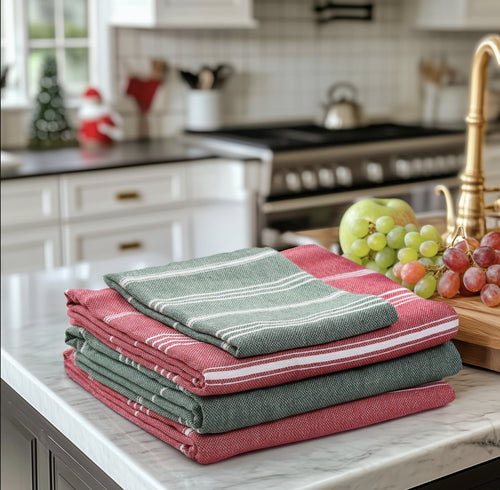
At Pestemal.com, we weave our pestemals in Denizli, Türkiye, on traditional shuttle looms as well as dobby and jacquard looms. GSM is set at the weaving stage through yarn choice and weave density, so it can be adjusted for each private label order. Alongside flat-woven pestemals, we also produce terry towels up to 500–550 GSM, which lets brands match weight and feel across a whole collection.
Frequently asked questions
What is a good GSM for a Turkish towel?
For most uses, around 200–250 GSM is a good all-round weight. Lighter suits beach and travel; heavier suits spas and bath use.
How do I calculate the GSM of a towel?
Weigh the towel in grams and divide by its area in square metres. For example, a 100×180 cm towel (1.8 m²) weighing 400 g is about 222 GSM.
Is 300 GSM thick for a pestemal?
Yes. 300 GSM is on the heavy side for a flat-woven pestemal, though it is still much lighter than a typical terry towel.
Why are pestemals lighter than terry towels?
Pestemals are flat-woven without loops, so they use less yarn per square metre. That makes them thinner, faster-drying and lighter to ship.
Can GSM be customised for private label orders?
Yes. GSM can be adjusted through yarn, weave and density. Agree the target GSM and tolerance with your manufacturer before production.